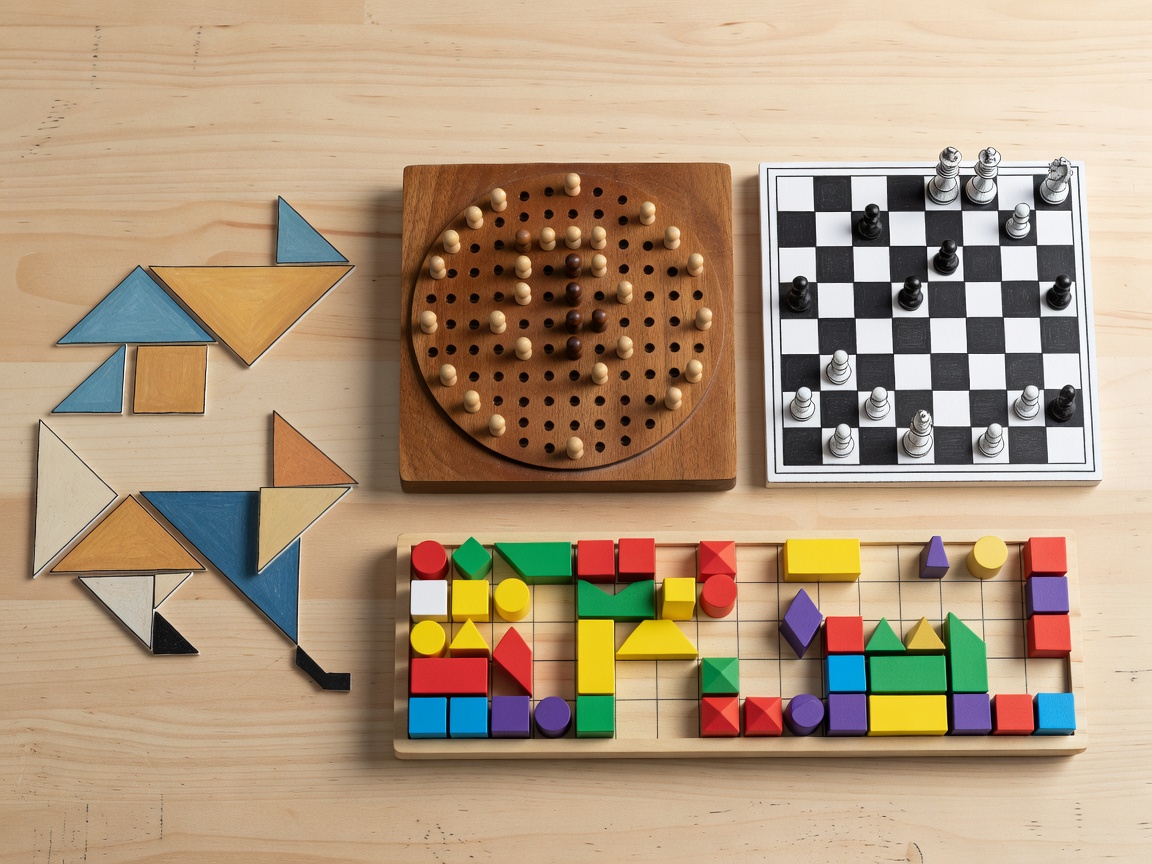
Different games ask different questions
“Brain game” is a roomy label. It can include spatial dissection puzzles, single-player board puzzles, chess compositions and abstract strategy games. The useful distinction is the kind of information the game presents. Some show everything and ask you to plan. Others conceal the right arrangement until you manipulate pieces. A few do both, because apparently one form of difficulty was insufficient.
Choose a format by the kind of effort you enjoy rather than by claims about mental improvement. A pleasant, repeatable challenge is more likely to earn your attention than a worthy-looking object that lives unopened on a shelf.
Tangrams: silhouette and decomposition
A traditional tangram uses seven flat pieces, called tans, arranged to make figures. The difficulty is not merely recognising a silhouette. It is seeing where the boundaries between pieces might lie. Start with large triangles and obvious outer corners, then test how the remaining shapes can meet without overlap.
Turning a piece changes its orientation; flipping it changes its handedness. In a physical tangram, the pieces can be turned over. In a printed version, check whether the challenge permits reflection before spending ten minutes trying to persuade a parallelogram to become its mirror image.
Peg solitaire: plan backwards
Peg solitaire usually begins with one empty hole and asks you to remove pegs by jumping one over another into an empty space. The goal is often to finish with a single peg. Every move reduces the number of pegs, so careless early moves cannot be repaired by adding material later.
Look for moves that preserve access to the centre and avoid isolating pegs. Working backwards from a likely final position can reveal what the penultimate move must look like. This is a useful habit in many puzzles: ask what must be true immediately before success, not only what looks attractive now.
Chess problems are not ordinary chess games
A chess problem presents a composed position and a stipulated task, often checkmate in a specified number of moves. The aim is to find the intended solution against every defence, not the move that would be most practical in a casual game. Key moves can be quiet, even apparently odd, because they create a precise set of replies.
Set the position carefully and inspect checks, captures and threats, but do not stop there. In a composed problem, a move’s value may lie in controlling a flight square or arranging a thematic response. The position is a machine, not a live opponent’s autobiography.
Mechanical puzzles and friction
Sliding-block puzzles, disentanglement puzzles and twisty puzzles add physical feedback. A clear mechanism is easier to learn from than one with vague movement or poor alignment. For a first encounter, choose a puzzle whose parts move smoothly and whose objective is obvious. Difficulty can come later; there is no need to begin with engineering tolerance as an additional boss battle.
Keep a short record
For repeatable challenges, note one useful observation after a session: a dead end in peg solitaire, a shape pairing in a tangram, or a defensive resource in a chess problem. This is not a productivity system. It is simply a way of preserving the interesting part after the pieces return to their box.