Start with the image, not the piece count
Piece count describes duration only roughly. Image structure often decides the real difficulty. A puzzle with a building façade, a map, a bookshelf or a garden has repeated but bounded regions: windows, labels, leaves and edges provide handles. A misty landscape can have fewer pieces and still become a long conversation with pale grey cardboard.
Look for changes in colour, direction and texture. Distinct objects create local targets. Strong outlines make it easier to tell whether a piece belongs to a particular area. This is not cheating. A jigsaw is an exercise in matching evidence, not a purity test administered by a lighthouse.
What the cut changes
Many traditional puzzles use a grid-like cut with familiar knobs and holes. Random-cut puzzles use more varied shapes and can feel less repetitive, though a very irregular piece is not automatically more informative. The useful question is whether shape and image cooperate. If every piece has a similar silhouette and the picture is mostly one colour, the table acquires an unplanned second job.
Wooden puzzles tend to use thicker pieces and may include whimsical shapes. Cardboard puzzles are easier to store and usually offer a larger image area for the money. Neither format is morally superior. Choose the surface, fit and scale that suit your table and patience.
A sorting method that does not become a ceremony
- Turn pieces image-side up, including the ones that have apparently joined a private union beneath the box lid.
- Separate edge pieces if the border is visually clear. If it is not, leave the border until the image gives you more information.
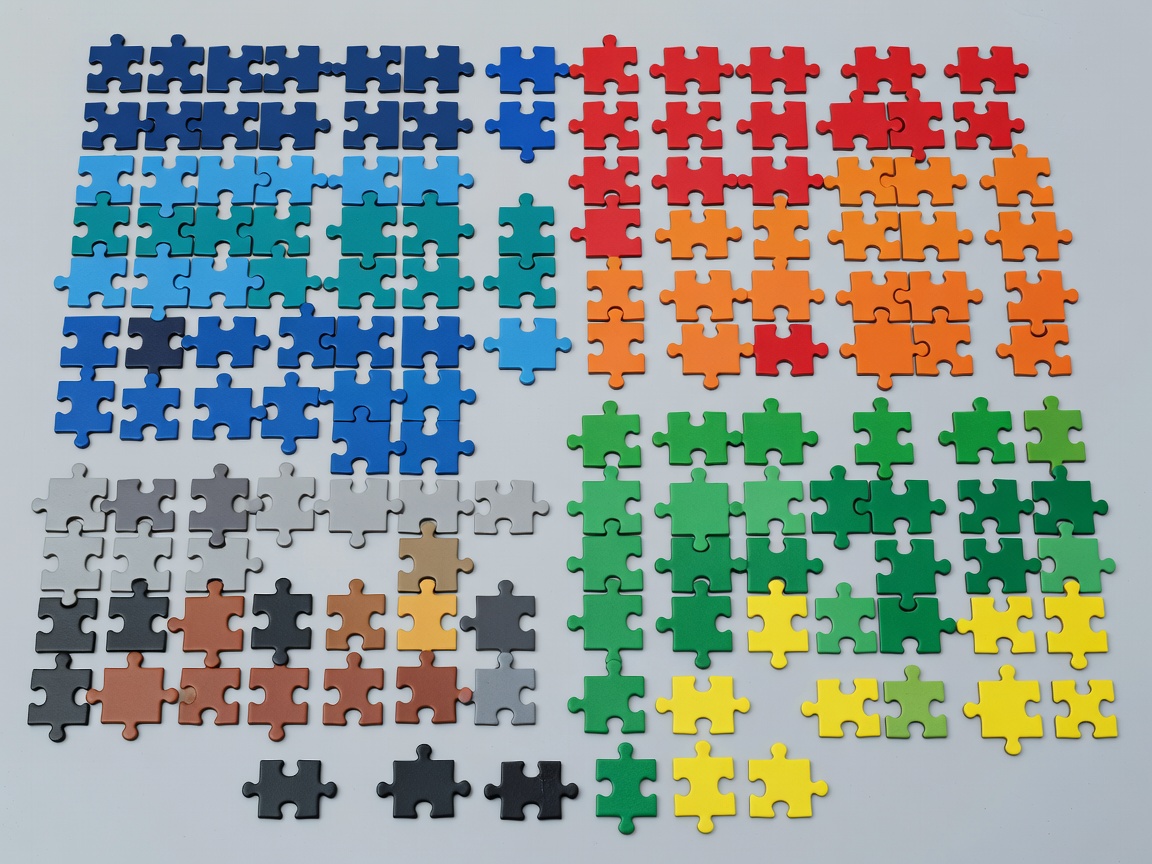
- Make a few broad groups: strong colours, lettering, recognisable objects and difficult background.
- Build small sections where image features are specific, then connect them when shape confirms the match.
Too many categories can be as unhelpful as none. The point is to reduce the field of view, not to create a tiny warehouse operation.
Border first is a habit, not a law
Completing the frame gives a useful boundary and can be satisfying in its own right. Yet it is often slow when the border has a uniform colour or when corner pieces are ambiguous. Some solvers begin with a bright central object, then work outward. Others build several islands. Both approaches use the same information; they simply spend attention in a different order.
Space, light and interruption
A firm, flat board helps pieces stay put when a section needs moving. Good light matters because subtle colour differences vanish under a warm, dim lamp. If the puzzle must leave the table between sessions, a portable board or a large sheet of card is more reliable than the ancient tradition of balancing it on a blanket.
Take breaks before every piece begins to resemble every other piece. Returning with rested eyes can make an overlooked line or colour shift obvious. The puzzle has not become kinder. You have merely stopped staring at it.
When a puzzle is not enjoyable
There is no prize for finishing an image that offers no pleasure. If the fit feels loose, the print is unclear, or the design gives you nothing to work from, set it aside. A good jigsaw alternates uncertainty with enough small confirmations to keep the process moving. That balance is the thing to seek, not an impressive-looking number on a box.