Deduction puzzles ask for proof, not hunches
Logic challenges include several families with different surfaces but a shared habit: each confirmed fact restricts what can happen next. The useful habit is to write down consequences as they arise. A puzzle is not asking you to keep every possibility in memory while looking serene about it.
Use light marks for possibilities and decisive marks for exclusions or confirmed entries. Keep the distinction consistent. If an annotation system is too elaborate to maintain, simplify it. A clear pencil note defeats an elegant notation you forget halfway through.
Nonograms: lengths and separation
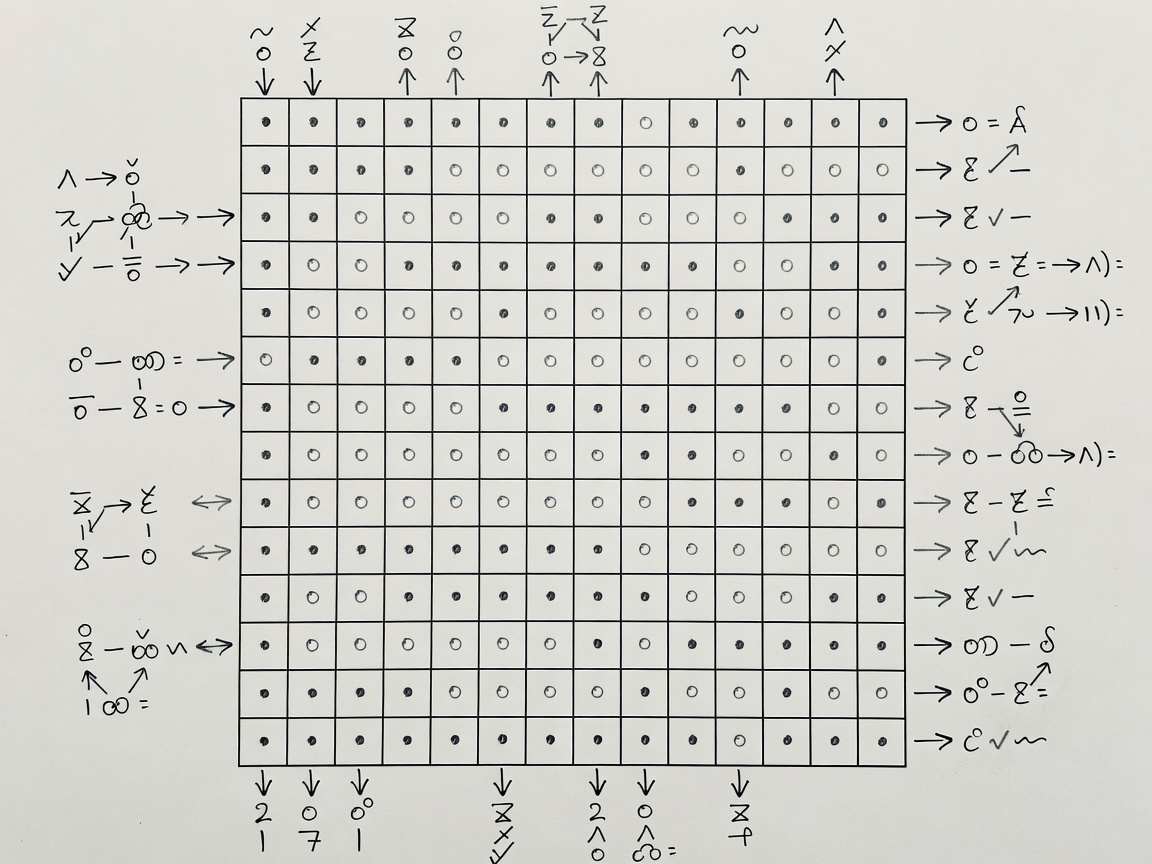
Nonograms, also called Picross, give numbers for each row and column. Each number describes a run of filled cells, and separate runs require at least one blank cell between them. The basic move is overlap: if a run is long enough that every legal placement covers certain cells, those cells can be filled immediately.
After placing a complete run, mark surrounding cells blank where the rules require it. This prevents later contradictions. Work between rows and columns; a single new filled cell often changes the available placements in the other direction. The emerging picture is pleasing, but treat it as confirmation rather than evidence. A vague cat-shaped blob is not a mathematical argument.
Kakuro: sums with no repeats
Kakuro combines crossword-like runs with number sums. Digits in each run do not repeat. A target total limits the possible digit combinations, while crossing runs restrict their order. Start with totals that have very few possible combinations. The smallest and largest sums for a given run length are especially constrained.
Record candidate digits rather than repeatedly recalculating them. As crossings settle, remove impossible candidates. Avoid guessing merely because a combination looks familiar; the no-repeat rule and the crossing total must both support the entry.
Slitherlink: one continuous loop
In Slitherlink, numbered cells indicate how many of their surrounding edges belong to a single loop. A zero excludes all four surrounding edges. A three in a corner forces the available edges. The loop cannot branch or close early around a small area if unsolved clues remain outside it.
It helps to scan for local patterns, then look for global consequences: a vertex may not have exactly one line entering it, and it may not have three. Keep an eye on isolated loops. They are temptingly complete and usually premature.
When to backtrack
Well-made logic puzzles are generally intended to yield through deduction, though some formats or difficulty levels can require a trial. If you make an assumption, label it and follow only its direct consequences. A contradiction tells you the assumption was wrong; it does not mean the puzzle has developed a personal grievance.
Choose by texture
Nonograms suit people who enjoy visual emergence. Kakuro suits arithmetic constraints. Slitherlink suits spatial patterning. Traditional logic grids suit language and elimination. All reward slow, inspectable reasoning. Pick the one whose marks you enjoy making, because you will make quite a few.